
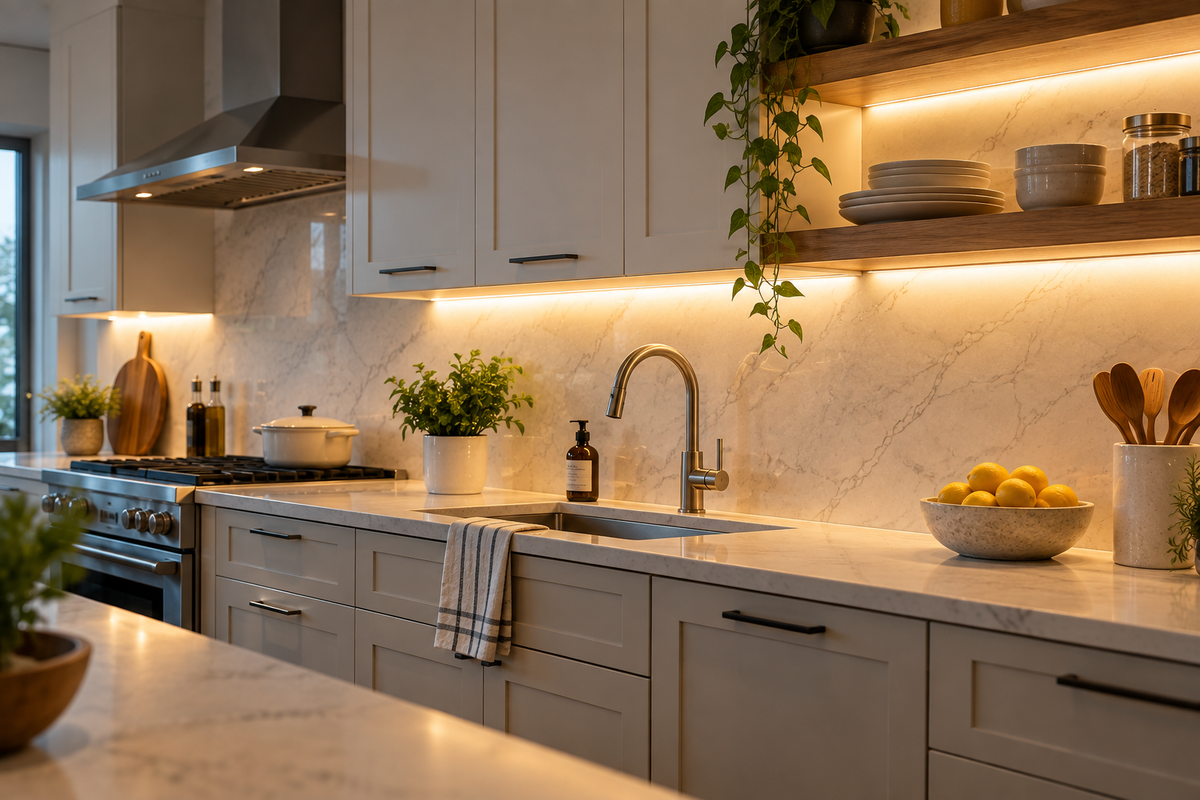
Flexible LED strips are a useful way to add linear lighting where conventional fixtures may be difficult to install. Their slim construction works well under cabinets, inside shelves, around architectural details, behind mirrors and in many other compact spaces.
The challenge is that flexible strips can look very similar until you start comparing the specifications.
Voltage, LED density, PCB width, light color and environmental protection can all affect whether a strip is suitable for a particular installation. Some projects may also benefit from special designs such as narrow PCB strips, dual-color strips or S-shape strips.
This guide explains the main differences to consider when choosing from the Flexible LED Strips collection.
Start With Where the Strip Will Be Installed
Before comparing individual specifications, decide what the strip needs to do.
Flexible LED strips can be used for applications such as:
- Under-cabinet lighting
- Shelf and display lighting
- Ceiling coves
- Mirror backlighting
- Bedroom accent lighting
- Furniture lighting
- Decorative outlines
- Selected low-voltage vehicle projects
A strip installed beneath a kitchen cabinet has different requirements from one used inside a narrow display shelf or around a curved decorative shape.
Start by measuring the installation area and thinking about whether the strip will be hidden, directly visible or viewed through a diffuser.
These basic decisions make the technical specifications much easier to understand.
12V or 24V?
The Flexible LED Strips collection contains both 12V and 24V products, depending on the model.
The most important requirement is compatibility. A 12V LED strip must be used with an appropriate 12V power supply, while a 24V strip requires a 24V power supply. Any controller installed between them must also be compatible with the system voltage.
When 12V Can Be a Practical Choice
12V strips are commonly used for short and medium-size low-voltage lighting projects such as cabinets, shelves, furniture and mirrors.
One representative option is the DC12V SMD2835 60 LEDs/m Flexible LED Strip.
This model uses an 8mm PCB and is available in several single-color options. Depending on the selected configuration, IP00 and IP67 versions are offered.
When to Consider 24V
The collection also includes 24V versions of several SMD2835 and SMD5050 strips.
For longer low-voltage runs, a properly designed 24V system can be useful because the higher operating voltage can help reduce current for the same overall power requirement. Actual installation length and power distribution still need to be calculated for the specific strip.
Rather than deciding that one voltage is universally better, choose the voltage as part of the complete system design.
Understand LED Density
LED density tells you how many LEDs are positioned along a given length of strip.
The current collection includes configurations such as:
- 60 LEDs/m
- 120 LEDs/m
- 150 LEDs/m
- 240 LEDs/m
- Selected 480 LEDs/m double-row designs
Higher density generally means that the individual LEDs are positioned closer together.
This can matter when you want the light to appear more continuous, especially when the strip is installed in a shallow channel or close to a reflective surface.
However, LED density should not be treated as a direct measurement of brightness. Two strips with different LED packages or electrical designs can produce different results even if their LED counts are similar.
60 LEDs/m
A 60 LEDs/m strip can work well for many general accent-lighting installations, particularly when the strip is hidden from direct view.
It can be a straightforward option for cabinet edges, coves and furniture details where very close LED spacing is not the main priority.
120 LEDs/m
A 120 LEDs/m strip places LEDs closer together and may create a more uniform appearance in installations where individual light points are more noticeable.
The collection includes several SMD2835 120 LEDs/m configurations with different PCB widths.
240 LEDs/m and Higher
Higher-density options are useful when close LED spacing is important to the design.
The collection includes a 240 LEDs/m SMD2835 strip and a selected double-row configuration with 480 LEDs/m.
These options should still be compared by their complete specifications rather than LED quantity alone.
Pay Attention to PCB Width
PCB width is one of the easiest specifications to overlook, but it can determine whether a strip actually fits the installation.
The collection includes PCB widths ranging from narrow options such as 4mm and 5mm to wider 8mm, 10mm and 15mm designs.
If the strip needs to fit inside a narrow recess or aluminum channel, measure the available width before ordering.
Narrow Installations
The DC12V SMD2835 120 LEDs/m 4mm PCB Strip is a good example of why PCB width matters.
Its 4mm PCB makes it suitable for projects where a standard 8mm or 10mm strip may be too wide.
This can be useful in slim shelves, narrow architectural details and compact profiles.
Wider Strips
Other products use 8mm or 10mm PCBs, while the double-row design uses a wider 15mm PCB.
Wider does not automatically mean better. It simply means the physical space required for installation is different.
Always check both the strip width and the internal dimensions of any mounting profile.
SMD2835 or SMD5050?
This collection contains both SMD2835 and SMD5050 strip designs.
These names describe the LED package used on the strip, but the package type should not be considered in isolation.
The collection uses SMD2835 across several PCB widths and LED densities, while selected SMD5050 strips use 10mm PCBs and are available in multiple single-color configurations.
Instead of choosing purely by the LED package name, compare:
- Voltage
- LED density
- PCB width
- Available color
- Protection option
- Physical installation requirements
The complete strip specification is more useful than the LED package alone.
Choosing the Light Color
The collection contains both white-light options and selected decorative colors.
Depending on the model, available choices include warm white, natural white, cool white and colors such as red, green, blue, pink, golden yellow and ice blue.
Not every color is available on every strip.
Warm White
Warm white is commonly used where a softer and more comfortable appearance is preferred. It works naturally in bedrooms, living areas, decorative shelving and warm-toned interiors.
Natural White
Natural white provides a more neutral appearance. It can be useful for cabinets, shelves and general-purpose installations where you do not want the light to appear strongly warm or cool.
Cool White
Cool white creates a cleaner and visually crisper appearance. It is often chosen for modern interiors, display areas and projects where a cooler white tone works better with the surrounding finishes.
The exact available color options should always be confirmed on the individual product page.
Single Color vs Dual Color
Most strips in this collection are single-color products. That means the customer selects a specific white tone or decorative color when ordering.
Certain models are different.
The DC12V SMD2835 Dual Color LED Strip combines warm white and cool white LEDs on the same 8mm PCB.
This type of strip can be useful when a project needs adjustable white-light appearance, provided a compatible control system is used.
It is important not to assume that all products in the collection provide color adjustment. Most remain single-color strips.
IP00 or IP67?
Protection requirements should be based on the installation environment.
Selected products in the collection are available in IP00 and IP67 configurations. Other products, including certain narrow, high-density and S-shape versions, are listed as non-waterproof.
IP00 and Non-Waterproof Strips
For dry indoor areas where the strip will not be exposed to moisture, a non-waterproof strip may be appropriate.
- Dry bedroom installations
- Interior shelving
- Ceiling coves
- Furniture
- Dry cabinet interiors
Selected IP67 Versions
Some models are available with IP67 protection. These can be considered where the strip itself requires additional protection from environmental exposure.
However, an IP-rated strip does not automatically make the complete lighting installation waterproof.
Connections, cut ends, wiring, controllers and power supplies must also be suitable for the installation environment.
Special Shapes for Curved Layouts
A standard flexible strip can bend along its intended direction, but it may not follow tight sideways curves easily.
For decorative outlines, lettering and irregular shapes, an S-shape strip can make routing easier.
The DC12V SMD2835 S-Shape LED Strip uses a 6mm PCB and is offered in several white and decorative color options.
This particular model is listed as non-waterproof.
For a straight cabinet run, a standard flexible strip is usually sufficient. For a curved decorative route, the S-shape construction may be more practical.
Quick Selection Guide
| Project Requirement | What to Consider |
|---|---|
| General cabinet lighting | 12V or 24V single-color strip with a suitable white tone |
| Narrow shelf or recess | 4mm or 5mm PCB options |
| Closer LED spacing | 120, 150 or 240 LEDs/m options |
| Very high LED density | Selected 480 LEDs/m double-row strip |
| Curved decorative layout | S-shape strip |
| Dry indoor project | IP00 or non-waterproof configuration may be suitable |
| Additional environmental protection | Selected IP67 models |
| Warm-to-cool white adjustment | Selected dual-color strip |
Think About Visibility and Diffusion
Where the strip is positioned affects how the light looks.
If the strip is deeply hidden inside a cove, individual LED points may be less noticeable. If it is close to a wall, glossy backsplash or reflective shelf, LED spacing can become easier to see.
An aluminum profile with a diffuser can help provide a more finished installation and can soften the appearance of individual points of light.
The depth of the profile, diffuser type and LED spacing all affect the final result. This is another reason why a higher-density strip is not automatically necessary for every project.
Plan the Power Supply Before Installing
The LED strip and power supply should be planned together.
Before purchasing a power supply, confirm:
- Strip voltage
- Installed length
- Power requirement of the selected model
- Required power-supply capacity
- Whether a controller will be used
- Wiring and connection layout
The output voltage of the power supply must match the LED strip.
For longer installations, power distribution should also be planned before the strips are mounted. Depending on the design, longer runs may require multiple feed points or separate sections.
Measure Before You Order
Before choosing a strip, measure more than just the total installation length.
- Available PCB width
- Mounting channel dimensions
- Space for connectors
- Cable routing
- Corner geometry
- Distance to nearby reflective surfaces
A strip that is only a few millimeters wider than expected may not fit inside a profile or recess.
For compact installations, PCB width can be just as important as voltage or LED density.
Common Buying Mistakes
Choosing by LED Count Alone
A higher LED count does not automatically mean a strip is the right choice. Consider LED spacing, strip construction, installation depth and the intended lighting effect together.
Ignoring PCB Width
Customers sometimes select the electrical specification first and only discover during installation that the strip is too wide for the channel. Measure before ordering.
Assuming Every Model Is Waterproof
Protection varies between products and configurations. Check the exact product page rather than assuming the whole collection shares one IP rating.
Mixing 12V and 24V Components
A 12V strip and 24V power supply are not interchangeable. The voltage of the strip, power supply and relevant controller must be compatible.
Planning the Power Supply Last
Power requirements should be calculated before installation, not after the strip has already been mounted.
Final Checklist
- Where will it be installed?
- Is the location dry or exposed to moisture?
- Does the project use 12V or 24V?
- What light color is required?
- How wide can the PCB be?
- Will the strip be directly visible?
- How important is close LED spacing?
- Does the installation include curves?
- Will a controller be required?
- Has the power supply been sized for the selected strip and installed length?
Conclusion
Flexible LED strips are useful precisely because there are many different configurations available.
Rather than looking for one strip that can do everything, start with the physical installation and desired lighting effect, then narrow the choices by voltage, LED density, PCB width, color and environmental protection.
You can compare the current options in the Flexible LED Strips collection before planning the rest of the system.

Leave a comment
This site is protected by hCaptcha and the hCaptcha Privacy Policy and Terms of Service apply.