
Walk into almost any modern lighting project today, and you'll find one challenge that comes up again and again: compatibility.
Lighting designers, electricians, and homeowners often spend more time figuring out whether a driver will work with a dimmer than they do selecting the actual fixtures. A system may look perfect on paper, but if the driver and control method don't communicate properly, the result can be flickering, limited dimming range, or lights that simply refuse to perform as expected.
This is one reason why 5-in-1 dimmable LED drivers have become increasingly popular in recent years.
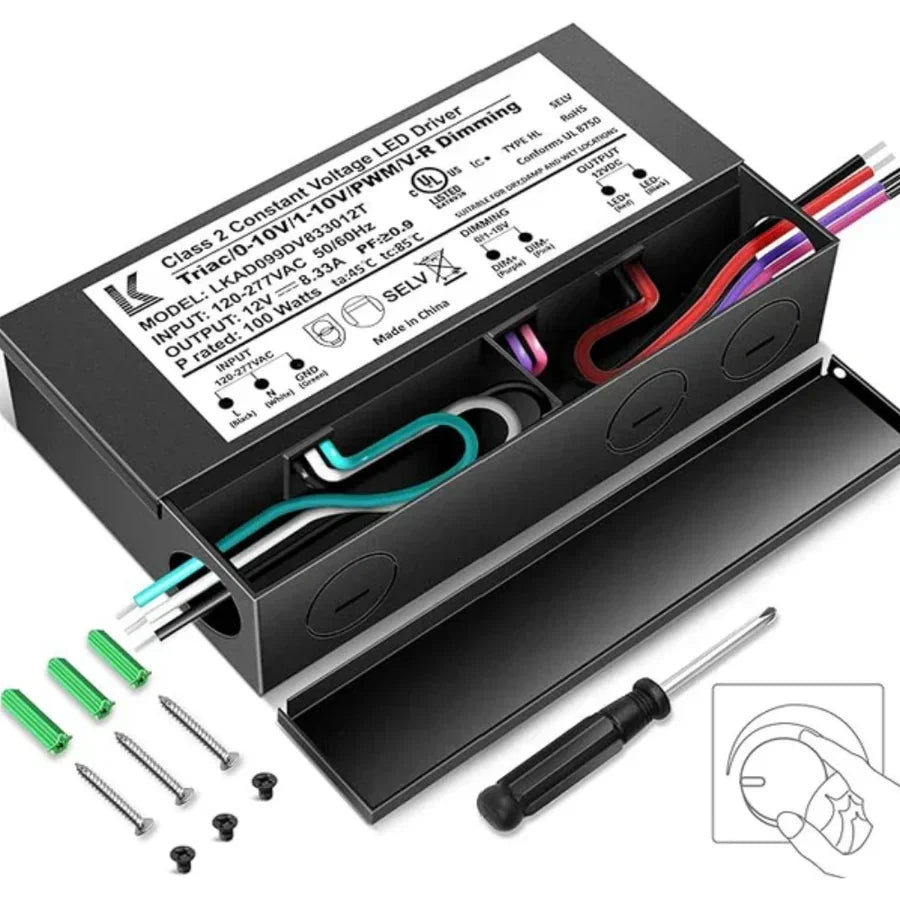
Instead of being limited to a single dimming technology, these drivers support multiple control methods within the same unit. Whether the project uses Triac, ELV, 0-10V, PWM, or a simple potentiometer, the driver can adapt to the control system without requiring a completely different power supply.
For contractors and installers, that flexibility often removes a significant amount of uncertainty from the planning process.
One of the most practical advantages is inventory simplification.
In the past, installers often needed to stock several different driver models to support different dimming requirements. A residential project might require Triac dimming, while a commercial project could use 0-10V controls. Managing multiple product lines increased both inventory costs and the chance of ordering mistakes.
With a multi-protocol driver, a single product family can cover a much wider range of applications.
This doesn't just save warehouse space. It also reduces delays caused by discovering compatibility issues after installation has already begun.
Another reason these drivers are becoming more common is the growing demand for adjustable lighting.
People no longer expect lighting to simply turn on and off. In homes, lighting is often adjusted throughout the day to create different moods and environments. In commercial spaces, dimming is used to improve comfort, reduce energy consumption, and adapt spaces for different activities.
A driver that can provide smooth dimming across multiple control systems gives designers and property owners much more freedom when planning a project.
The difference may seem small on paper, but in a finished space, stable and consistent dimming can significantly improve the overall experience.
Reliability also plays a major role.
A well-designed dimmable driver does more than regulate voltage. It helps protect the lighting system from performance issues that may develop over time. Stable output, thermal protection, and consistent dimming behavior all contribute to longer system life and fewer maintenance concerns.
For larger installations, that reliability often becomes more valuable than any single technical specification.
When selecting a dimmable driver, wattage and output voltage remain important considerations, but they are no longer the only factors that matter.
Compatibility with existing controls, future flexibility, installation requirements, and long-term performance have become equally important parts of the decision.
That shift explains why many lighting professionals now view 5-in-1 dimmable drivers not as a specialty product, but as a practical standard for modern LED lighting projects.

Leave a comment
This site is protected by hCaptcha and the hCaptcha Privacy Policy and Terms of Service apply.