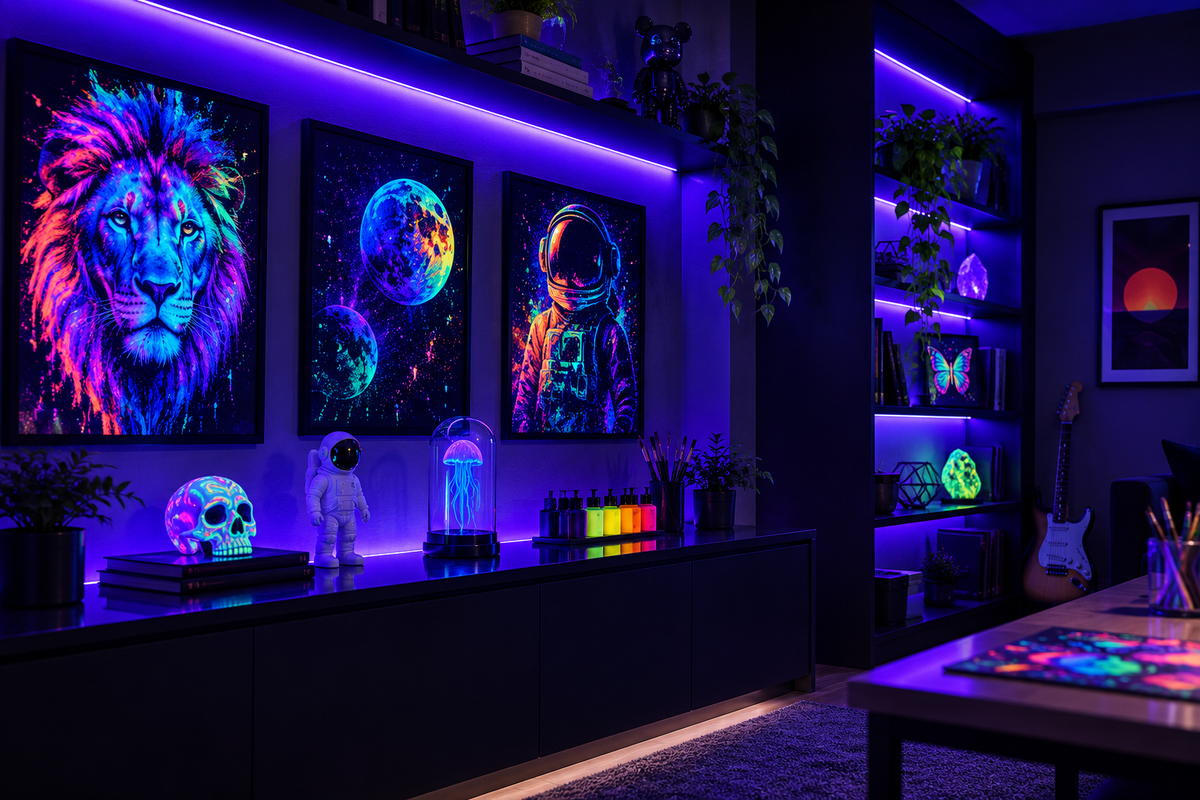
UV LED strips are often grouped together under the term “blacklight,” but not every UV strip produces the same visual effect.
One of the most important specifications is wavelength.
A 365–370nm strip behaves differently from a 380–385nm strip, and both can look noticeably different from a 395–405nm strip. The right choice depends on whether the goal is stronger fluorescence excitation, a more visible violet-blacklight effect, a decorative installation or a portable party-lighting setup.
The UV LED Strips collection includes several wavelength ranges, LED densities and protection options.
What Does UV Wavelength Mean?
UV LED wavelength is measured in nanometers, usually written as “nm.”
- 365–370nm
- 380–385nm
- 395–405nm
- 385–400nm on the USB-powered model
As wavelength increases toward 400nm, the emitted light generally becomes more visibly violet to the human eye. Shorter wavelengths within this group tend to produce less visible purple light while being useful where fluorescence excitation is the main objective.
365–370nm: For Fluorescence-Focused Applications
The 365–370nm UV LED Strip is designed for fluorescent displays, UV-reactive artwork, decorative installations, display cabinets and exhibition features.
Compared with longer-wavelength blacklight strips, the visible purple component can be less dominant. That can be useful when the goal is to emphasize fluorescent materials rather than make the light source itself visually prominent.
380–385nm: A Middle Ground
The 380–385nm UV LED Strip is positioned for fluorescence enhancement, decorative displays and accent-lighting applications.
This wavelength range can be useful when you want strong interaction with fluorescent materials while accepting somewhat more visible violet light than you would typically expect from the shorter 365nm range.
395–405nm: The More Visible Blacklight Look
The 395–405nm UV LED Strip is specifically listed for blacklight effects, fluorescent decoration, party spaces and mood lighting.
Because this wavelength range is closer to visible violet light, the strip itself tends to produce a more noticeable purple-violet appearance.
Quick Wavelength Comparison
| Wavelength | Typical Visual Character | Suitable Applications |
|---|---|---|
| 365–370nm | Less visible violet, fluorescence-focused | UV-reactive displays, artwork, exhibits |
| 380–385nm | Balanced fluorescence and visible violet effect | Displays, decorative features, accent lighting |
| 395–405nm | More noticeable violet-blacklight appearance | Parties, mood lighting, blacklight decoration |
| 385–400nm | Broad blacklight range on USB model | Portable decoration, parties, temporary setups |
Not All Fluorescent Materials React the Same Way
Different pigments, dyes and materials have different excitation characteristics. A fluorescent object that reacts strongly under one UV source may look different under another.
If the project involves a specific material or artwork, testing the actual material with the intended wavelength is the most reliable approach.
SMD2835 vs SMD5050
The DC12V UV strips in this collection are available in both SMD2835 and SMD5050 configurations depending on the model.
Instead of choosing by LED package alone, compare wavelength, LED density, PCB width, power requirement, waterproof configuration and installation length.
Understanding LED Density
The main DC12V UV strip families include density options such as:
- 30 LEDs/m
- 60 LEDs/m
- 120 LEDs/m
- 240 LEDs/m
Higher LED density places the LEDs closer together and can provide more evenly distributed illumination over a given length. LED count alone should not be treated as a direct measurement of UV intensity.
PCB Width Changes With Configuration
Different LED-density and package combinations do not all use the same PCB width. Selected configurations use 8mm, 10mm or 15mm PCBs depending on LED type and density.
Always confirm the physical width of the exact configuration before ordering.
DC12V UV Strips
Most of the main UV strip families in this collection operate on DC12V.
These products do not connect directly to household AC power. A compatible DC12V power supply must be selected according to the exact strip model, installed length and power requirement.
A 5V USB-Powered Option
The collection also includes the 385–400nm SMD3528 USB Powered UV LED Strip.
This model operates on 5V USB power and uses 60 LEDs/m. It is a non-waterproof product designed for portable blacklight, party and temporary decorative setups.
Do not connect this 5V product to a 12V supply.
A 395–405nm Kit With Power Adapter
The 24W / 60W SMD2835 395–405nm UV LED Strip Kit is offered with a power adapter.
It uses DC12V, SMD2835 LEDs and a 60 LEDs/m layout, with non-waterproof and selected IP65 options.
Non-Waterproof, IP65 or IP67?
Non-Waterproof
Non-waterproof UV strips are intended for dry indoor environments and should be kept away from water, condensation and continuously damp locations.
IP65
Selected IP65 products provide additional surface protection against moisture and splashing.
IP67
Selected 365–370nm and 380–385nm products are also available in IP67 configurations.
The 380–385nm IP67 UV LED Strip uses a protected silicone-tube construction.
An IP-rated strip does not automatically make the complete installation waterproof. Cut ends, connectors, wiring, controllers and power supplies must also be suitable for the environment.
Choosing a UV Strip for a Fluorescent Display
- Identify the fluorescent material
- Decide whether visible purple light should be minimized or emphasized
- Test the material if possible
- Choose the wavelength range
- Decide how much area must be illuminated
- Select LED density
- Choose the protection rating
- Plan the power supply
For displays where fluorescence is the main visual feature, 365–370nm or 380–385nm may be worth comparing first. For a more obvious blacklight atmosphere, 395–405nm may be more suitable.
Choosing a UV Strip for Parties and Mood Lighting
For entertainment spaces, 395–405nm products are particularly relevant because they produce a more noticeable violet-blacklight effect.
The USB-powered 385–400nm model can also be useful for temporary or portable installations.
Installation Distance Matters
UV lighting performance changes with distance.
Before permanently installing the strip, test distance from the target, direction of illumination, coverage area, shadows, reflections and visibility of the LEDs themselves.
UV Safety Matters
UV LEDs emit ultraviolet radiation. Do not look directly into operating UV LEDs. Avoid unnecessary exposure of eyes and skin, particularly during close-range installation, testing or maintenance. Use appropriate UV eye and skin protection where required.
Common Mistakes to Avoid
Choosing Only by How Purple the Strip Looks
The visible violet color does not tell you everything about how effectively a strip will excite a particular fluorescent material.
Assuming 365nm and 405nm Are Interchangeable
They are different wavelength ranges with different visual characteristics.
Assuming Every UV Strip Is Waterproof
The collection contains non-waterproof, IP65 and IP67 products depending on the model.
Connecting a 12V Strip Directly to AC Power
The DC12V products require an appropriate low-voltage power supply.
Using the Wrong Voltage With the USB Strip
The USB model operates at 5V, not 12V.
Quick Selection Guide
| Project | Good Starting Point |
|---|---|
| Fluorescent artwork/display | Compare 365–370nm and 380–385nm |
| Blacklight party room | 395–405nm |
| Decorative UV accent | 380–385nm or 395–405nm depending on desired look |
| Portable party setup | 385–400nm USB model |
| Dry indoor installation | Non-waterproof configuration |
| Area needing splash protection | Selected IP65 configuration |
| Area needing greater moisture protection | Selected IP67 configuration |
Final Checklist
- What wavelength does the application require?
- Is stronger fluorescence or visible violet light more important?
- What material will be illuminated?
- How far will the strip be from the target?
- How much area needs to be covered?
- Which LED density is suitable?
- Does the environment require IP65 or IP67 protection?
- Is the strip 5V or 12V?
- Is a compatible power supply included?
- Have UV exposure and warning requirements been considered?
Conclusion
Choosing a UV LED strip starts with wavelength. Once the wavelength matches the application, you can narrow the choice by LED density, voltage, protection level and installation format.
Explore the UV LED Strips collection to compare current 365–370nm, 380–385nm, 395–405nm and USB-powered UV lighting options.

Laisser un commentaire
Ce site est protégé par hCaptcha, et la Politique de confidentialité et les Conditions de service de hCaptcha s’appliquent.