
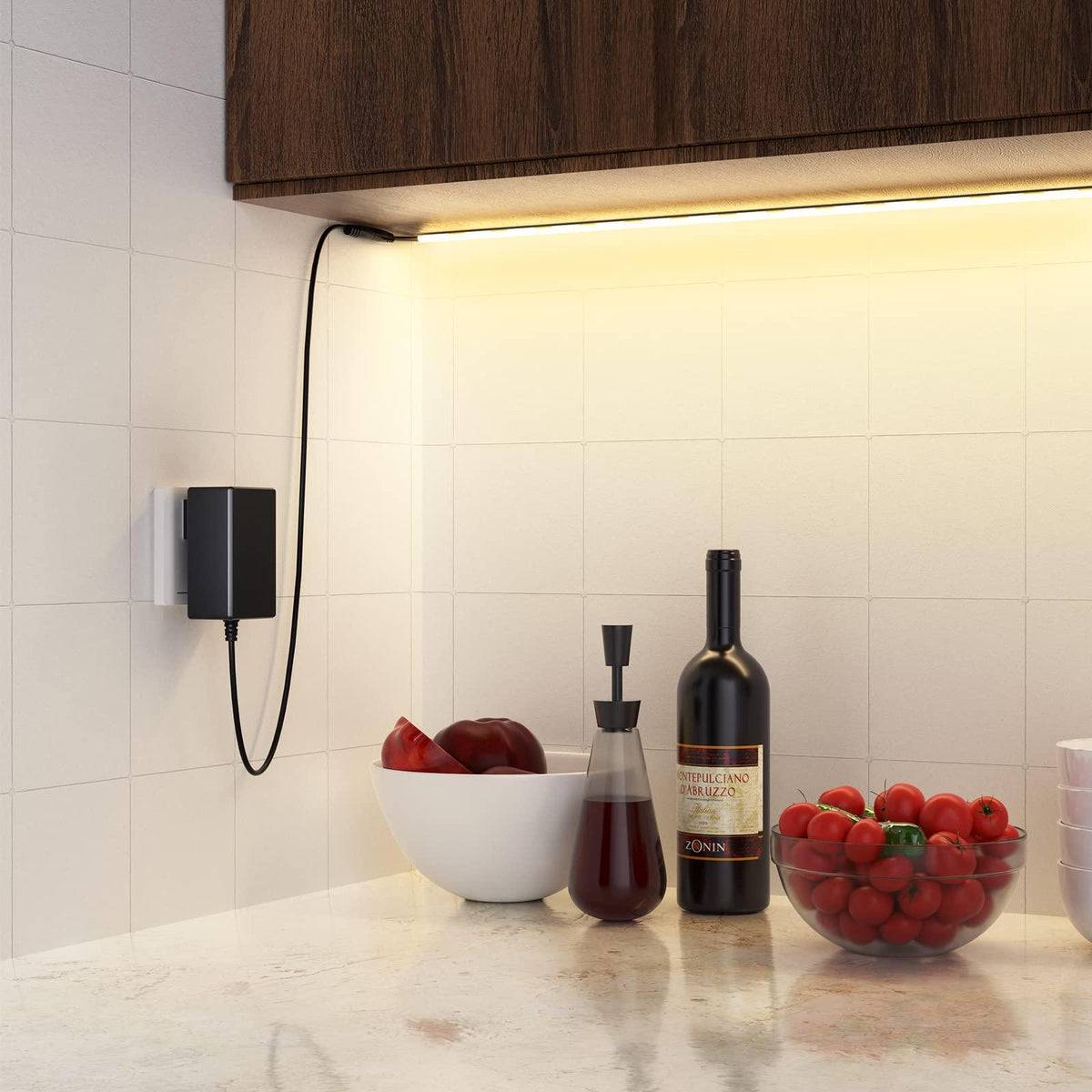
Plug-in LED power adapters provide a convenient way to power compatible low-voltage LED strips, cabinet lights and decorative lighting systems without installing a separate metal-enclosed power supply.
However, not all LED adapters are interchangeable. Two adapters may look almost identical while delivering different output voltages, current ratings or connector configurations.
Choosing the wrong adapter can cause lights to malfunction or damage connected equipment.
In this guide, we'll explain how to select a plug-in LED adapter based on voltage, wattage, connector compatibility, switching features and installation conditions.
What Is a Plug-in LED Power Adapter?
A plug-in LED power adapter converts AC electricity from a wall outlet into the DC electricity required by compatible low-voltage lighting.
Unlike many metal-enclosed switching power supplies that use screw terminals, a typical plug-in adapter connects directly to a wall outlet and supplies power through an attached DC cable.
This design can be convenient for smaller lighting installations.
Common applications include:
- Under-cabinet LED strip lighting
- Bookshelf and display lighting
- Decorative LED strips
- Compatible LED modules
- Small home lighting projects
- Low-voltage accent lighting
Some adapters also include inline switches, detachable connector accessories or specialized output connections.
Before selecting an adapter, it is important to confirm the electrical requirements of the connected lighting system.
Step 1: Choose the Correct Output Voltage
Output voltage is the first specification to check.
A plug-in adapter must provide the voltage required by the LED strip or lighting device.
DC 5V LED Adapters
5V adapters are designed for compatible 5V DC devices.
The LightingWill collection includes 5V plug-in adapters with 15W and 25W options.
These may be suitable for compatible small LED modules or other 5V lighting equipment, depending on their current requirements.
DC 12V LED Adapters
12V adapters are commonly used with compatible 12V LED strip lighting.
LightingWill offers several 12V plug-in adapter configurations, including 12W, 24W and 36W models.
Selected versions feature an inline on/off switch.
DC 24V LED Adapters
24V adapters are intended for lighting systems rated for 24V DC input.
The collection includes 24V models with power ratings such as 24W, 48W and 72W.
A 24V adapter must not be connected directly to a 12V-only LED strip.
Important: Never choose an adapter based on its physical appearance alone. Always check the output voltage printed on the adapter and specified for the connected device.
Step 2: Calculate the Required Wattage
After confirming the correct voltage, calculate how much power your lighting system requires.
For LED strips, use the following formula:
Total Wattage = Power per Meter × Strip Length
For example, consider a 12V LED strip rated at 4.8W per meter.
If the installation uses 3 meters:
4.8W × 3m = 14.4W
The connected LED strip requires approximately 14.4W at its rated operating conditions.
A 12V 12W adapter would not provide sufficient rated capacity for this load.
A compatible 12V 24W adapter may be suitable, provided its output current, connector and other requirements also match.
For continuous operation, consider the manufacturer's load and temperature limits rather than selecting an adapter solely because its rated wattage slightly exceeds the calculated load.
Step 3: Understand Output Current
Voltage, wattage and current are closely related.
The formula is:
Current (A) = Power (W) ÷ Voltage (V)
For example:
- A 12V 12W adapter provides a nominal 1A output.
- A 12V 24W adapter provides a nominal 2A output.
- A 12V 36W adapter provides a nominal 3A output.
- A 24V 48W adapter provides a nominal 2A output.
- A 24V 72W adapter provides a nominal 3A output.
| Adapter Rating | Nominal Output Current |
|---|---|
| 5V 15W | 3A |
| 5V 25W | 5A |
| 12V 12W | 1A |
| 12V 24W | 2A |
| 12V 36W | 3A |
| 24V 24W | 1A |
| 24V 48W | 2A |
| 24V 72W | 3A |
These calculations represent nominal values derived from the listed voltage and wattage. Always confirm the exact adapter's rated output current.
A compatible constant-voltage adapter can have a higher current capacity than the load requires. The connected lighting draws the current it needs, up to the adapter's rated capacity.
Step 4: Check DC Connector Compatibility
One of the most common mistakes when replacing an LED adapter is overlooking the connector.
Many plug-in LED adapters use cylindrical DC barrel connectors, but these connectors are available in different sizes and electrical configurations.
Before purchasing, check:
- Connector outer diameter
- Connector inner diameter
- Connector polarity
- Whether the device uses a barrel connector or screw terminal
- Whether an adapter cable or converter is required
- Whether the connector is rated for the expected current
A connector that physically fits is not necessarily electrically compatible.
Connector Polarity
DC connectors have positive and negative electrical contacts.
Some devices use center-positive connections, while others may use a different arrangement.
Always confirm polarity using the equipment's markings or specifications.
Adapters With Multiple Connector Tips
Some LightingWill plug-in adapter listings include multiple connector tips or terminal accessories.
These can provide flexibility when connecting compatible equipment.
However, additional connector tips do not make an adapter compatible with every voltage, polarity or device.
Step 5: Decide Whether You Need an On/Off Switch
Some plug-in LED adapters include an inline on/off switch.
This can be convenient for lighting systems that do not have a separate switch or controller.
For example, an inline switch may be useful for:
- Under-cabinet LED strips
- Bookshelf lighting
- Display shelves
- Small decorative lighting projects
- Workbench accent lighting
Instead of unplugging the adapter every time, the user can operate the switch installed along the cable.
However, an on/off switch is not the same as a dimmer.
Unless the specific product states otherwise, do not assume the switch supports brightness adjustment.
Step 6: Choose Between Black and White Housings
The LightingWill collection includes black and white plug-in LED adapters.
Although housing color does not determine electrical performance, it can affect how discreetly the adapter fits into an installation.
White Adapters
White housings may blend more naturally with light-colored walls, white cabinetry and bright interiors.
Black Adapters
Black housings may be less noticeable near dark furniture, black power strips or darker display equipment.
Choose the color that fits the surrounding installation, but prioritize voltage, power and connector compatibility.
Step 7: Check AC Input and Plug Type
The adapter's AC input must be compatible with the available wall outlet.
Several products in this collection list AC 100–240V input, but the exact rating should be confirmed for each model.
Also check the plug type.
Some products are listed with US plugs, while selected models offer other plug configurations.
Before purchasing, verify:
- The local AC voltage is within the adapter's rated input range.
- The plug matches the intended outlet.
- The adapter is suitable for the intended region.
- The power cord reaches the lighting installation.
- The outlet remains accessible when required.
A physical travel plug converter does not automatically change the adapter's electrical input rating.
Step 8: Understand Specialized Adapter Types
Not every product in the collection is intended for ordinary indoor LED strip lighting.
Cigarette Lighter Socket Adapters
Some products convert household AC input into a 12V cigarette lighter-style socket output.
These are intended for compatible devices that use that type of connection.
They should not be confused with a standard DC barrel-output adapter.
IP44 Class 2 Plug-in Adapters
Selected products are designed for compatible outdoor decorative lighting systems.
The collection includes IP44 Class 2 models with different DC outputs, including 4.5V and 12V options.
IP44 describes a specified degree of enclosure protection, but it does not mean the adapter can be submerged or exposed to every outdoor condition.
Check the exact product's installation instructions, connector requirements and environmental limitations.
Step 9: Plan a Safe Installation
Plug-in adapters simplify some aspects of low-voltage lighting installation, but safe placement is still important.
Follow these basic principles:
- Use the adapter only within its rated input and output specifications.
- Keep indoor-only adapters away from rain and moisture.
- Do not cover the adapter with insulation, fabric or other materials that trap heat.
- Avoid crushing or sharply bending cables.
- Keep connectors secure.
- Do not overload the adapter.
- Use appropriate outdoor-rated equipment where required.
- Disconnect power before modifying connections.
Do not use an adapter if its housing, plug or cable is damaged.
Step 10: Plug-in Adapter vs Metal Switching Power Supply
Both types convert AC electricity into DC power, but their installation arrangements can differ.
| Feature | Plug-in LED Adapter | Metal Switching Power Supply |
|---|---|---|
| AC connection | Typically plugs into an outlet | Often uses screw terminals |
| DC connection | Attached cable and connector | Often uses output terminals |
| Installation | Convenient for compatible small systems | Often requires planned electrical installation |
| Common use | Cabinet lights, small LED strips | Larger or distributed lighting systems |
| Switching | Some models include inline switches | Depends on system design |
| Main consideration | Connector and plug compatibility | Wiring, enclosure and ventilation |
A plug-in adapter may be the more convenient choice for a small compatible lighting project.
For larger installations requiring multiple connections or higher total output, a suitable metal-enclosed power supply may be worth considering.
Explore the LightingWill LED Switching Power Supply collection for alternative power supply designs.
Common Mistakes When Buying Plug-in LED Adapters
Choosing the Wrong Voltage
A 24V adapter is not a replacement for a 12V adapter.
Ignoring Output Current
The adapter must have enough rated current for the connected load.
Assuming All DC Barrel Plugs Are Identical
Connector size and polarity must match.
Confusing an On/Off Switch With a Dimmer
A basic inline switch does not necessarily provide brightness control.
Ignoring the AC Plug Type
Confirm regional plug compatibility before purchasing.
Using Indoor Adapters Outdoors
Outdoor use requires a product specifically suitable for the intended conditions.
Overloading a Small Adapter
Calculate the total connected load before installation.
Using an Adapter With the Wrong Output Connector
A cigarette lighter socket adapter and a barrel-output adapter serve different connection requirements.
Quick Selection Guide
| Application | Adapter Type to Consider | Key Requirement |
|---|---|---|
| Small 5V LED device | DC 5V adapter | Correct current and connector |
| 12V cabinet LED strip | DC 12V adapter | Total wattage |
| 24V LED strip | DC 24V adapter | Matching 24V input |
| Lighting without a separate switch | Adapter with inline switch | On/off operation |
| Device with a specialized DC connector | Compatible multi-tip adapter | Size and polarity |
| Device using a cigarette lighter socket | 12V socket-output adapter | Connector and current |
| Compatible outdoor decorative lights | Specified IP44 Class 2 adapter | Exact system compatibility |
Final Checklist
Before purchasing a plug-in LED power adapter, confirm:
- What DC output voltage does the device require?
- Is the device designed for constant-voltage power?
- What is the total wattage?
- What output current is required?
- Does the adapter have sufficient rated capacity?
- Does the connector physically fit?
- Does the connector polarity match?
- Is a special connector tip required?
- Does the AC input match the local electricity supply?
- Is the plug type correct?
- Is an inline on/off switch needed?
- Is the cable long enough?
- Is the adapter intended for indoor or outdoor use?
- Does the installation allow appropriate heat dissipation?
- Are all accessories compatible with the lighting system?
Conclusion
Choosing the right plug-in LED power adapter involves more than selecting a convenient wall plug.
The most important factors are output voltage, total wattage, rated current and connector compatibility. Features such as an inline switch, housing color or multiple connector tips should be considered after the electrical requirements are confirmed.
For small LED strip and cabinet lighting projects, a compatible plug-in adapter can provide a straightforward power solution without the wiring arrangement of a metal-enclosed switching supply.
Explore the LightingWill Plug-in LED Adapter collection to compare available voltage options, wattage ratings, housing styles and connector configurations.


Commenta
Questo sito è protetto da hCaptcha e applica le Norme sulla privacy e i Termini di servizio di hCaptcha.