
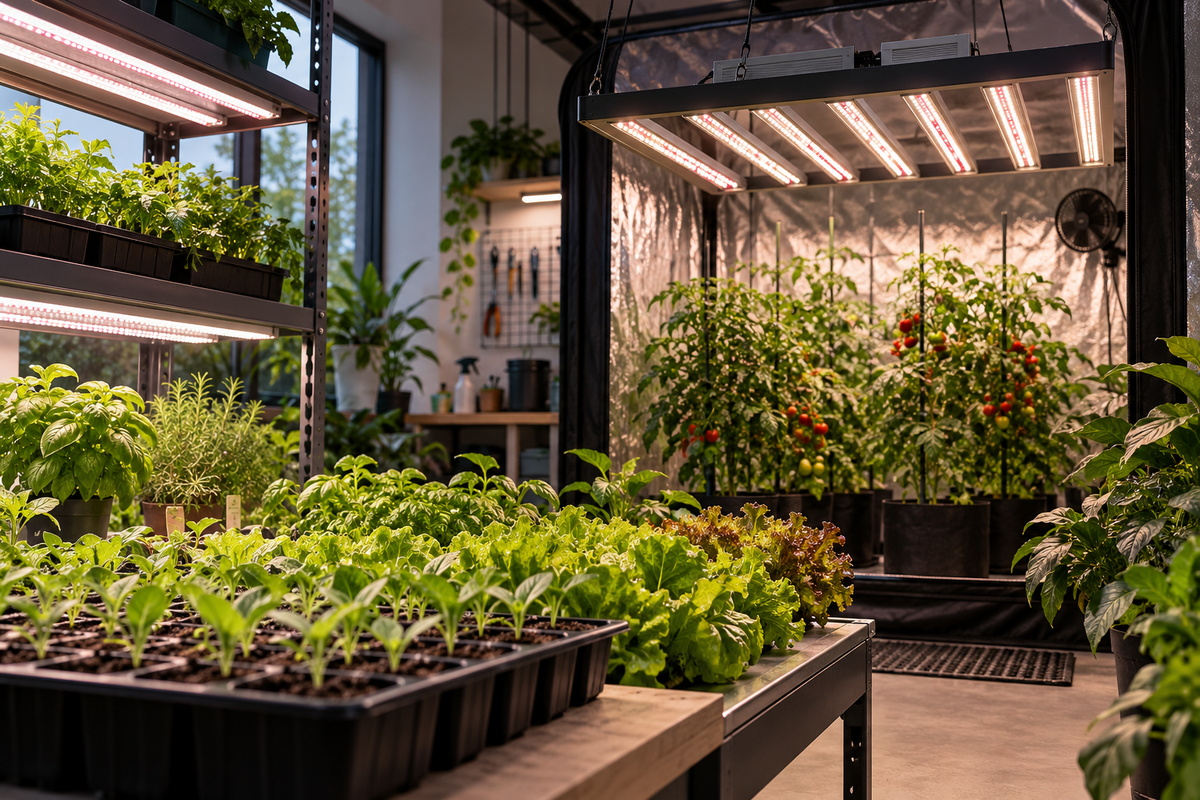
Choosing an LED grow light starts with a simple question: what are you actually trying to grow, and how large is the growing area?
A grow light for a few seedlings on a shelf does not need the same fixture as a light for a 4×4 ft grow tent. A single houseplant may only need a compact adjustable lamp, while a dense indoor canopy requires much more deliberate coverage, hanging height and power planning.
The LED Grow Lights collection includes compact seed-starting systems, USB-powered plant lights, tube fixtures, quantum boards and larger professional full-spectrum fixtures.
The right choice depends less on finding the highest wattage and more on matching the light to the plant stage and physical growing space.
Start With the Growing Setup
Before comparing wattage, spectrum or PPFD, first identify the type of growing setup.
- Seed-starting trays
- A single houseplant
- Several potted plants
- Shelf or rack growing
- Herbs and leafy greens
- Grow tents
- Indoor grow rooms
- Greenhouses
- Vertical growing racks
- Larger commercial cultivation areas
A compact USB halo lamp is convenient for one potted plant, but it would not provide the same coverage as a suspended multi-bar grow fixture.
1. Seed Starting: Choose Compact, Close-Range Lighting
Seedlings usually grow in a relatively small area.
At this stage, a compact light that can sit close to the tray is often easier to use than a large suspended fixture.
The collection includes a 40-Cell Seed Starter Tray with LED Grow Lights with adjustable brightness and timer functions.
This type of product can be useful for vegetable seeds, herbs, flowers and small indoor propagation projects.
2. A Single Houseplant: Use a Small Adjustable Plant Light
A single plant on a desk, shelf or floor does not need a large grow panel.
The Potted Plants LED Grow Light is designed for smaller indoor plant setups.
- 5V USB power
- Adjustable height
- 10 brightness levels
- 3H / 9H / 12H timer options
- Stake or desk-base installation
- Red/white or red/blue/white spectrum options
This style works particularly well when there are only one or two plants and a hanging fixture would be impractical.
3. Shelves and Plant Racks: Consider Tube Grow Lights
Shelves create a different challenge because the vertical distance between each shelf can be limited.
The collection includes a 60cm / 2FT LED Tube Grow Light system with six tubes and a 65W dimmable power supply.
Its listed spectrum includes 3000K, 5000K, 660nm and 460nm, with daisy-chain support and selectable mounting brackets.
This format can work well for plant shelves, seedling racks, herbs, leafy greens and greenhouse shelving.
4. Small Grow Tents: Look at Coverage, Not Wattage Alone
Once you move from a shelf or potted plant to a grow tent, coverage becomes much more important.
The GP Series includes professional full-spectrum fixtures from 100W through 400W.
- 100W: seedlings, clones and small grow tents
- 150W: small indoor grows, herbs and leafy greens
- 200W: medium grow tents
- 300W: larger grow tents and higher plant density
- 400W: large grow rooms and commercial applications
The exact wattage should be selected according to tent dimensions, plant density, growth stage, hanging height and desired light intensity.
5. Medium Grow Areas: Quantum Boards Can Be a Compact Choice
Quantum-board style grow lights use a relatively flat LED panel.
The collection includes 45W and 80W full-spectrum quantum panels as well as 65W / 85W / 120W / 150W ultra-thin quantum-board configurations.
This format can be useful where vertical clearance is limited and a compact suspended fixture is preferred.
6. Larger Grow Tents: Use Dimming and Coverage Together
Selected professional grow lights support 0–10V dimming so output can be adjusted for different plant stages and canopy conditions.
Some models also provide remote control and daisy-chain functions for larger multi-light systems.
Dimming can be useful when plants are young, the fixture is mounted closer to the canopy or several fixtures overlap.
7. Commercial and High-Density Growing: Consider Bar Fixtures
For larger indoor growing areas, multi-bar fixtures distribute LEDs across a much wider physical area.
The Foldable LED Grow Light is offered in several high-output configurations including 240W, 360W, 480W and a larger 700W-class version.
This type of fixture is intended for grow rooms, larger grow tents, vertical racks, greenhouses and professional cultivation facilities.
What Does Full Spectrum Mean?
Full-spectrum grow lights do not all use exactly the same LED combination.
Depending on the model, the spectrum may include:
- Warm white
- Cool or neutral white
- Blue wavelengths
- Deep red 660nm
- Far-red / IR
- UV
Always compare the exact spectrum of the selected product rather than assuming every full-spectrum light is identical.
Seedling, Vegetative Growth and Flowering
Many larger grow lights are designed for multiple growth stages.
However, that does not mean every plant should receive the same intensity throughout the entire cycle.
Hanging height, dimming level, daily light duration and fixture spacing may need to change as the plants develop.
What Does PPFD Tell You?
Selected professional grow lights publish PPFD measurements.
PPFD describes the amount of photosynthetically active radiation reaching a surface and can be more useful than wattage alone when evaluating plant-light intensity.
Always check the measurement distance because PPFD changes significantly with fixture height.
Wattage Is Not the Same as Coverage
Two grow lights with the same wattage may distribute their light very differently.
A compact board may concentrate more light near the center, while a multi-bar fixture can spread output across a larger canopy.
Compare fixture dimensions, recommended coverage, PPFD information, hanging height and plant density rather than wattage alone.
Dimming: When Is It Useful?
Selected products provide 0–10V dimming, built-in dimming knobs or remote-control brightness adjustment.
Dimming makes a larger fixture easier to adapt to different plant stages and canopy densities.
Timer Functions
Timer functions are particularly useful for compact household grow lights.
The potted-plant grow light, for example, includes 3H / 9H / 12H timer options.
Daisy Chain for Multi-Light Installations
Selected professional models support daisy-chain operation for multi-fixture installations.
This can be useful for grow tents, indoor grow rooms, commercial racks and greenhouse setups.
The number of supported fixtures varies by model, so always check the exact product specification.
Hanging Height Matters
A grow light mounted too close to the canopy can create excessive intensity or uneven coverage.
A fixture mounted too far away may not provide enough useful light.
The appropriate height depends on fixture type, wattage, plant stage, plant species, dimming level and canopy density.
Think About Heat and Airflow
Larger LED grow lights still release heat into the growing environment.
Depending on the model, heat management may include passive aluminum cooling, external drivers or built-in fans.
Grow tents and enclosed grow rooms should therefore still have appropriate airflow and ventilation.
Waterproof Ratings Are Model-Specific
Do not assume every grow light in the collection is waterproof.
Selected professional fixtures provide higher IP protection, while many compact indoor models are intended for dry indoor use.
Always check the exact protection rating for greenhouse, humid or irrigation-heavy environments.
Quick Grow Light Selection Guide
| Growing Setup | Good Starting Point |
|---|---|
| Seed starting | 40-cell seed starter grow-light tray |
| One or two houseplants | 5V USB potted-plant halo grow light |
| Plant shelf or rack | 2FT LED tube grow-light system |
| Small indoor grow | 45W / 80W quantum panel or smaller quantum board |
| Small grow tent | 100W–150W professional grow light |
| Medium grow tent | Approx. 150W–200W professional fixture |
| Larger grow tent | 300W–400W professional fixture |
| Large canopy / commercial grow | 240W–700W+ multi-bar fixture |
Common Buying Mistakes
Choosing by Wattage Alone
Wattage does not tell you how evenly the fixture distributes light across the canopy.
Buying Too Large a Fixture for a Small Setup
A commercial grow light is unnecessary for a single potted plant or small seed tray.
Ignoring Coverage
Always compare fixture size and recommended grow area.
Assuming Every Full-Spectrum Light Uses the Same Spectrum
Spectrum combinations vary between products.
Ignoring Dimming
For larger grow lights, dimming can make the fixture easier to adapt to different growth stages.
Assuming Every Model Is Waterproof
IP ratings vary by product.
Ignoring Hanging Height
Distance from the canopy changes both light intensity and coverage.
Final Checklist
- What plants are being grown?
- Is the light for seed starting, vegetative growth, flowering or general houseplant support?
- How large is the growing area?
- Is the setup a shelf, grow tent, greenhouse or open room?
- How much vertical clearance is available?
- Does the fixture need to be dimmable?
- Is a timer important?
- Will multiple fixtures need daisy-chain control?
- Does the environment require an IP-rated fixture?
- Does the selected light provide appropriate coverage for the actual canopy?
Conclusion
There is no single LED grow light that fits every indoor growing project.
For seed starting and houseplants, compact lights with timers and simple adjustment can be more practical than high-power fixtures. Shelves benefit from narrow tube lights, while grow tents and larger indoor gardens require more attention to wattage, coverage, PPFD, dimming and hanging height.
The best starting point is always the growing area itself.
Explore the LED Grow Lights collection to compare compact plant lights, seed-starting systems, tube fixtures, quantum boards and professional full-spectrum grow lights.

Commenta
Questo sito è protetto da hCaptcha e applica le Norme sulla privacy e i Termini di servizio di hCaptcha.