
Flexible LED strips are easy to associate with decorative lighting, but their usefulness goes well beyond adding a glowing line to a room.
Placed correctly, a strip can illuminate a kitchen worktop, brighten a display shelf, create indirect ceiling light, add soft illumination behind a mirror or make built-in furniture feel more integrated into the room.
The key is to treat the strip as part of the space rather than simply attaching it wherever there is an available surface.
This application guide looks at practical ways to use products from the Flexible LED Strips collection and explains what to consider before choosing a strip for each type of installation.
1. Under-Cabinet Lighting in the Kitchen
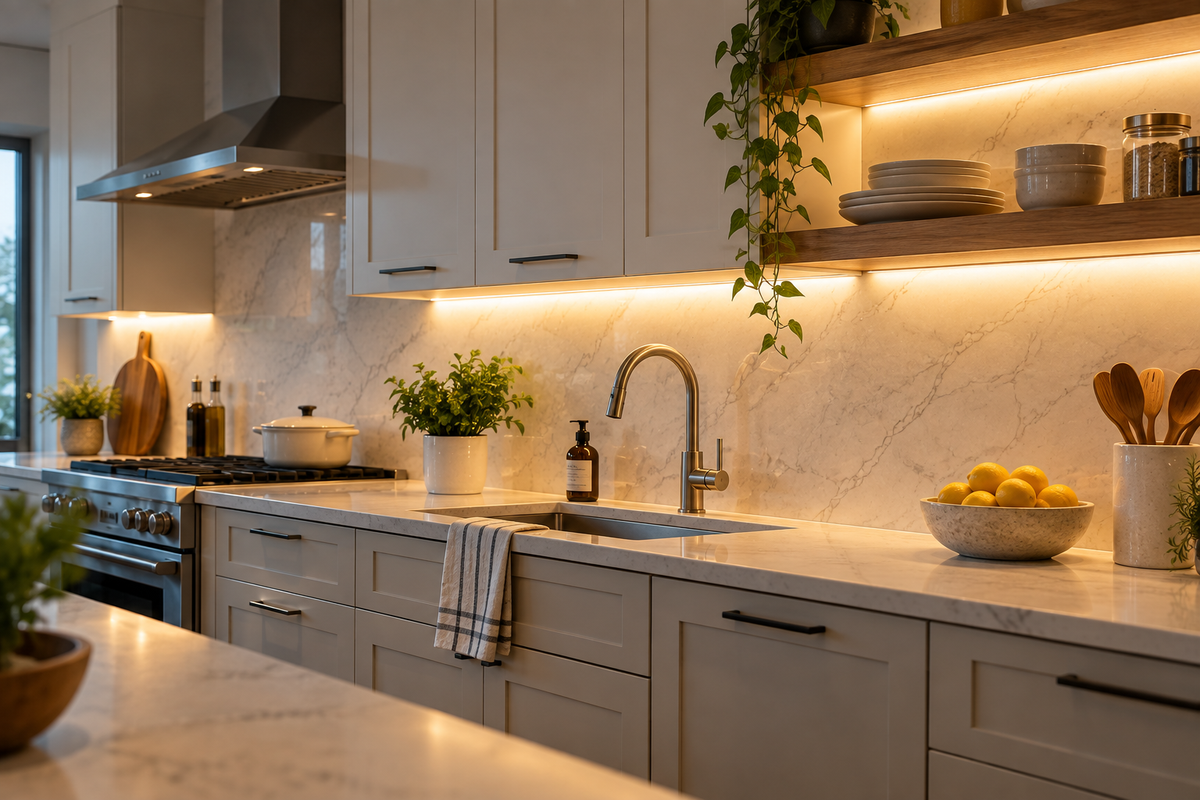
Under-cabinet lighting is one of the most practical uses for flexible LED strips.
Upper cabinets can block some of the room's ceiling light, leaving the countertop underneath darker than the rest of the kitchen. Installing a strip beneath the cabinet brings light closer to the work surface.
This can be useful around:
- Food-preparation areas
- Coffee stations
- Small appliance zones
- Sink areas
- Decorative backsplash sections
Hide the Strip From Direct View
For a cleaner installation, position the strip so that people standing in the room do not look directly at the LEDs.
Depending on the cabinet design, the strip can be installed toward the front edge, farther back near the backsplash or inside an aluminum profile.
The right position depends on whether the goal is to illuminate the countertop or mainly create a decorative glow.
Think About Reflections
Glossy stone, polished tile and glass backsplashes can make individual LED points more visible.
In these situations, a higher LED density or an aluminum profile with a diffuser may help produce a smoother appearance.
For compact spaces where mounting width is limited, a narrow option such as the DC12V SMD2835 120 LEDs/m 4mm PCB Strip can fit where a wider strip may not.
This particular model uses a 4mm PCB and is available in warm white, natural white and cool white.
2. Shelf and Display Lighting
Shelves are another natural place for flexible strips because the lighting can be integrated without taking up much visible space.
- Bookshelves
- Display cabinets
- Retail shelving
- Built-in wall units
- Glass shelving
- Collectible displays
Lighting Down From the Shelf Above
A strip installed underneath a shelf can illuminate the objects below it.
This arrangement works well in bookcases and display cabinets because each level can receive its own light.
Try to keep the strip hidden behind the front edge or inside a shallow channel rather than leaving the LED PCB directly visible.
Backlighting the Shelf
Another approach is to position the strip toward the back.
Instead of directly lighting the objects from above, the strip washes light onto the rear panel or wall.
This tends to create a softer decorative effect and can help give built-in shelving more visual depth.
3. Ceiling Coves and Indirect Lighting
Flexible LED strips are particularly useful when the light source is meant to disappear.
A ceiling cove hides the strip behind an architectural edge and allows the light to reflect from the ceiling or upper wall.
Important factors include:
- Distance between the strip and ceiling
- Direction the strip faces
- Surface color
- Cove depth
- LED spacing
- Total run length
A white or light-colored ceiling generally reflects light more effectively than a dark surface.
Avoid Seeing the LEDs From Normal Viewing Angles
The strip should normally remain hidden when viewed from the main area of the room.
If individual LEDs can be seen from across the room, the cove may feel more like an exposed strip installation than indirect architectural lighting.
Testing a short section before completing the entire perimeter can help determine the right position.
4. Mirror Backlighting
Flexible LED strips can also be installed behind mirrors to create a halo of indirect light around the edge.
- Bathroom-style vanity mirrors
- Bedroom mirrors
- Dressing areas
- Decorative wall mirrors
The strip is normally positioned behind the mirror rather than directly facing the viewer. Light then reflects from the wall and creates a softer illuminated outline.
Leave Enough Distance From the Wall
If the mirror sits very close to the wall, the illuminated halo may appear narrow and intense.
More spacing between the mirror and wall usually allows the light to spread across a larger area.
Where moisture may be present, check the protection rating of the exact strip and make sure the complete electrical installation is suitable for the environment. Do not assume that every strip in the collection is waterproof.
5. Bedroom Accent Lighting
Bedrooms are often better suited to indirect lighting than exposed bright LED points.
Flexible strips can be hidden:
- Behind a headboard
- Beneath a floating bed frame
- Behind wall panels
- Inside recessed shelving
- Above wardrobes
- Along selected architectural details
Behind a Headboard
Placing a strip behind a headboard can create a gentle glow on the wall.
The effect usually looks cleaner when the LED strip itself cannot be seen from the bed or doorway.
Under a Bed Frame
A strip beneath a raised bed can create low-level indirect illumination.
The installation works best when the strip is positioned far enough inward that it is not directly visible when standing in the room.
6. Built-In Furniture and Cabinets
LED strips are useful in custom furniture because they require very little mounting space.
- Wardrobes
- Display cabinets
- Media units
- Floating shelves
- Sideboards
- Storage niches
For very narrow furniture details, PCB width becomes particularly important.
The current Flexible LED Strips collection includes different strip widths, including narrow configurations designed for compact mounting areas.
Measure the installation channel before choosing the product. Even a difference of a few millimeters can determine whether the strip fits properly.
7. TV and Media Wall Accent Lighting
A strip positioned behind a TV, media panel or floating console can add indirect light without introducing another visible fixture.
For a restrained residential look, the strip can be used simply to wash the wall with white light.
The location of the strip affects the result. Placing it close to the edge of a panel produces a more defined halo, while moving it inward tends to make the light less directly visible.
8. Stairs and Railings
Flexible strip lighting can be incorporated into selected stair and railing details where the structure provides an appropriate concealed mounting location.
- Beneath a handrail
- Along a recessed stair detail
- Under selected stair nosings
- Within adjacent architectural channels
The strip should be placed so that it does not create distracting direct glare.
If a strip could be stepped on, touched repeatedly or physically damaged, simply sticking exposed LED tape onto the surface is usually not a suitable installation method.
9. Curved Decorative Shapes
Standard flexible strips bend easily in their intended direction, but they are less suited to tight sideways turns.
Projects involving curved outlines, decorative lettering, irregular shapes, display graphics or custom furniture curves may benefit from a strip specifically designed to follow lateral curves.
The DC12V SMD2835 S-Shape LED Strip uses a 6mm PCB and an S-shape layout that makes curved routing easier than with a conventional straight PCB.
This specific model is non-waterproof and is offered in several white and decorative colors.
10. Display Windows and Commercial Shelving
Flexible strips can also be incorporated into display windows, product shelves, retail fixtures, light boxes, exhibition furniture and hospitality interiors.
The small physical size of a strip makes it easier to conceal the light source inside display structures.
For applications where accurate color appearance is particularly important, check the CRI specification of the individual product rather than assuming that every strip has the same color-rendering performance.
11. Decorative Lines and Architectural Details
A flexible strip can also be used to emphasize a wall recess, ceiling edge, floating panel, display niche, furniture outline or textured wall.
This type of installation works particularly well when the strip follows an existing architectural feature.
Rather than creating a glowing line in an arbitrary location, use the lighting to reinforce the shape that is already present in the room.
Choosing the Right White Tone for the Space
Warm White
Warm white can complement wood, beige stone, warm metals and relaxed residential interiors.
Natural White
Natural white offers a more neutral appearance and can work well for kitchens, shelves, work areas and general-purpose interior lighting.
Cool White
Cool white creates a more visually crisp appearance and may suit modern displays and interiors with cooler finishes.
There is no single correct color temperature for every application. Consider the surrounding materials and the color of the room's existing lighting.
How LED Density Changes the Visual Effect
LED density becomes particularly important in applications where the light reflects from a nearby surface.
A lower-density strip can be appropriate when hidden deep inside a cove, while a higher-density strip can help reduce visible spacing when mounted close to a reflective surface.
The collection includes multiple density options depending on the model, including 60, 120, 150 and 240 LEDs/m, with selected double-row designs reaching 480 LEDs/m.
Installation depth, diffusion and viewing distance matter just as much as density.
Application Quick Guide
| Application | Main Considerations |
|---|---|
| Kitchen cabinets | Strip position, reflections, white tone, mounting width |
| Display shelves | Concealment, LED spacing, direction of light |
| Ceiling coves | Indirect reflection, run length, hidden placement |
| Mirror backlighting | Wall distance, strip position, environment |
| Bedroom | Indirect light, glare control, white tone |
| Furniture | Narrow mounting space, PCB width |
| Media walls | Wall reflection and concealed placement |
| Stairs and railings | Glare, protection and secure mounting |
| Curved shapes | Consider an S-shape strip |
| Retail displays | Concealed placement and product color appearance |
Plan the Installation Before Applying the Strip
A good LED strip installation begins before the adhesive backing is removed.
- Plan the exact strip location
- Choose the power-supply location
- Plan cable routing
- Identify connection points
- Plan cut points
- Check corners and curves
- Choose aluminum profiles if required
- Keep future maintenance in mind
Test the lighting before completing the permanent installation. A short test can reveal unwanted LED spotting, reflections or glare before the full installation is finished.
Do Not Forget the Power System
Flexible LED strips require a compatible low-voltage power system.
Depending on the selected product, the strip may operate at 12V or 24V.
The power supply must match the strip voltage and provide suitable capacity for the connected load. Controllers must also be compatible where they are used.
For longer installations, power distribution may require additional planning rather than simply connecting an unlimited length of strip end to end.
Conclusion
Flexible LED strips work particularly well when the light is integrated into the architecture or furniture instead of becoming the main visual object.
Under cabinets, the strip can illuminate a work surface. Behind a mirror or headboard, it can create indirect light. Inside a shelf or ceiling cove, it can add depth without requiring a visible fixture. Special designs can also make narrow or curved installations easier.
The most successful result comes from deciding what the light should do first and then choosing the strip around that application.
Explore the Flexible LED Strips collection to compare available widths, LED densities, voltages, light colors and protection options for your project.

Commenta
Questo sito è protetto da hCaptcha e applica le Norme sulla privacy e i Termini di servizio di hCaptcha.